JillLebofsky may earn a commission if you buy through links on this page, at no extra cost to you. That does not change what we report.
Part of our ViriFlow overview. Last checked October 28, 2026.
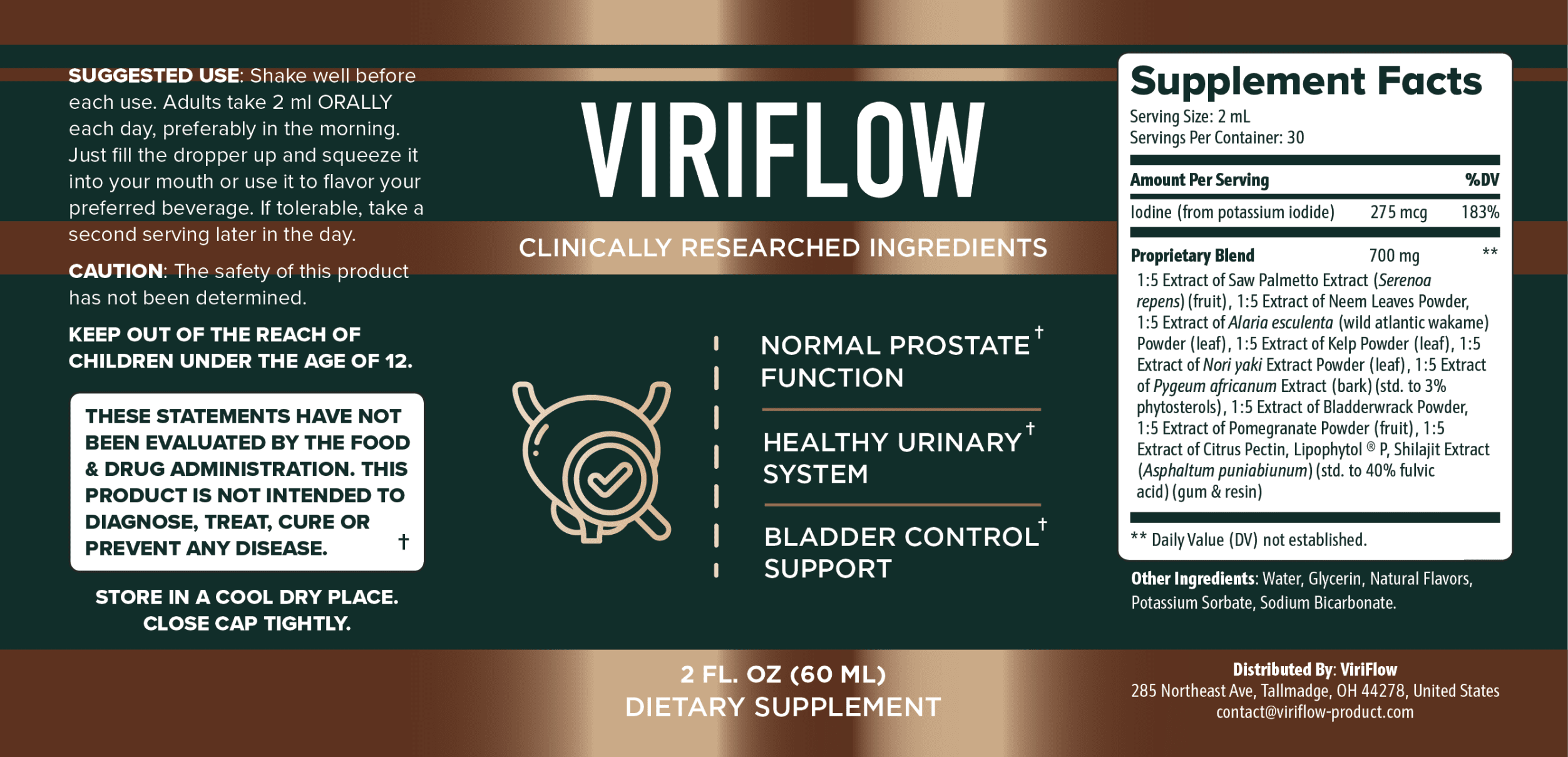
Does ViriFlow work? There is no evidence that it does, because no published trial has tested the ViriFlow liquid, and its label hides every herbal dose inside one 700 mg blend.[1] Its best-known ingredient, saw palmetto, was tested in a 2023 Cochrane review of 27 studies and 4,656 men, which found it "provides little to no benefits" for urinary symptoms from an enlarged prostate.[4]
Does ViriFlow work? The short answer
We cannot say it works, and the label makes it impossible to judge from the ingredients either. The 700 mg proprietary blend holds 11 items, about 64 mg each on average, and the real split is not disclosed.[1] No dose can be compared with the amounts used in prostate studies.
What can be concluded: saw palmetto failed large placebo-controlled trials even at three times the usual dose.[6] Pygeum has modest, older positive data at about 100 mg a day of a standardized extract.[7] The four seaweeds and shilajit have no human prostate trials at all. The only disclosed amount, 275 mcg of iodine, has no prostate evidence behind it.[10]
The vendor's explanation also differs from medicine. The sales page blames "toxic mineral buildup from hard water".[2] NIDDK describes an enlarged prostate (BPH) as non-cancerous growth that becomes common with age, affecting 29% to 33% of men 65 and older.[3]
Which evidence levels should you not confuse?
Four kinds of evidence get blended together in supplement marketing, and only the last two tell you whether a product works.
Plausibility
Lab or animal findings that an ingredient could act on the prostate. Shilajit's data are this kind: mouse and cell studies, no human prostate trial.[9] Plausibility is a reason to run a trial, not a result.
Ingredient trials
Human trials of one ingredient at a stated dose. Saw palmetto and pygeum have these. They only apply to ViriFlow if ViriFlow contains the same extract at a similar dose, which the label does not let you check.
Finished-product trial
A placebo-controlled trial of ViriFlow itself. We found none. The vendor's references page lists studies but no trial of the product, and it includes the 2006 STEP trial, in which saw palmetto did no better than placebo.[5]
Replication
The same result found again by independent teams. The one positive wakame-type trial, a purified Undaria fucoidan extract in 95 men, is a single industry-linked study with no repeat yet.[8]
ViriFlow claims vs what the evidence supports
The vendor's main claims go well past what the studies measured. The table puts each claim, quoted from the sales page and FAQ on October 28, 2026, next to the evidence.
| Vendor claim | Reasonable reading | Limitation |
|---|---|---|
| Prostate growth comes from "toxic mineral buildup from hard water"[2] | A sales story, not a diagnosis | NIDDK does not list hard water as a cause of BPH[3] |
| "Clears inflammation, flushes out toxic buildup, strengthens the prostate"[2] | Untested for this product | No trial of ViriFlow; blend doses hidden[1] |
| "CLINICALLY RESEARCHED INGREDIENTS" (label front)[1] | Some ingredients have been studied | Saw palmetto's research is mostly negative[4] |
| "Optimally dosed proprietary blend"[2] | Cannot be checked | About 64 mg per item on average vs 320 mg/day saw palmetto and 100 mg/day pygeum in trials[6][7] |
| "Fast-acting"; results in "around 9-12 weeks"[2] | The two statements conflict | No timing data for the product |
| Ingredients "proven to be safe in clinical trials"[11] | Overstated | The label says "The safety of this product has not been determined"[1] |
Which ViriFlow ingredients matter most?
Saw palmetto and pygeum are the two with real prostate trials, and both were tested at doses ViriFlow may not reach.
- Saw palmetto: trials used 320 mg a day of a fruit extract, and CAMUS went up to 960 mg a day for 72 weeks with no benefit over placebo.[6] ViriFlow's share is unknown.
- Pygeum: the Cochrane review of 18 trials and 1,562 men found men were twice as likely to report improvement, but trials were small, averaged 64 days and used standardized extracts at 75 to 200 mg a day.[7]
- Wakame: the positive trial used purified fucoidan from Undaria pinnatifida.[8] ViriFlow lists Alaria esculenta, a different seaweed, as a 1:5 whole extract.[1]
- Pomegranate: a placebo-controlled trial in men with rising PSA after prostate cancer treatment found no PSA benefit.[12]
Population matters too. The trials enrolled men over 45 with moderate symptoms, not men without symptoms looking for prevention. Ingredient detail is on our ViriFlow ingredients page.
What results are realistic to expect?
Going by the trials, small changes at best, and only for the ingredients that were tested at known doses. On saw palmetto, the Cochrane short-term result was a 0.90-point drop on a 35-point symptom scale over 3 to 6 months, which the authors call little to no difference.[4] In CAMUS, men on placebo improved 2.99 points, more than the 2.20 points on saw palmetto.[6]
The fucoidan trial found a 3.40-point drop vs 0.93 on placebo over 90 days, with no change in urine flow, leftover urine or PSA.[8] No trial in our sources showed prostate shrinkage. Saw palmetto does not change PSA, so it will neither improve nor hide a PSA result.[9]
When should you see a doctor instead?
See a doctor before trying any prostate supplement if you have new urinary symptoms, because NIDDK notes they can come from bladder problems, infections, prostatitis or prostate cancer.[3] Get care right away if you:
- cannot urinate at all;
- have urgent, painful urination with fever and chills;
- see blood in your urine;
- have great pain in your lower belly or urinary tract.[3]
Ask about a PSA test as part of that visit. NIDDK lists alpha blockers, 5-alpha reductase inhibitors and other options for BPH that have been studied far more than any blend.[3]
Evidence conclusion
ViriFlow has not been shown to work, and its hidden doses mean the ingredient research cannot fill that gap.
| Decision question | Current assessment, checked October 28, 2026 |
|---|---|
| Has ViriFlow been tested in a trial? | No published trial found |
| Can label doses be matched to studies? | No; only iodine (275 mcg) is disclosed |
| Best-studied ingredient | Saw palmetto: little or no benefit |
| Strongest positive signal | Pygeum: limited, older, short trials |
| Main safety question | Iodine from potassium iodide plus four seaweeds; see side effects |
Back to the ViriFlow overview.
Frequently asked questions
Is there any clinical study on ViriFlow?
We found no published trial of the ViriFlow liquid as of October 28, 2026. The vendor cites ingredient studies, including the 2006 STEP trial, in which saw palmetto did no better than placebo for enlarged prostate symptoms.
How long does ViriFlow take to work?
The vendor says supplements take around 9 to 12 weeks, while also calling the formula fast-acting. No study measured ViriFlow, so there is no tested timeline. The refund window is 60 days from delivery, shorter than the 12 weeks suggested.
Can ViriFlow shrink an enlarged prostate?
There is no evidence it can. No trial of the product exists, and in the STEP trial saw palmetto did not change prostate size over one year. Pygeum trials also showed no evidence of shrinkage.
Is ViriFlow better than prescription BPH medicine?
No comparison exists. NIDDK lists alpha blockers and 5-alpha reductase inhibitors as standard BPH medicines. ViriFlow has no trial, and its saw palmetto ingredient showed little or no benefit over placebo in a 2023 Cochrane review.
Will ViriFlow affect my PSA test?
Saw palmetto does not change PSA levels, according to NCCIH and the CAMUS trial, so it neither lowers nor hides a PSA result. No PSA data exist for ViriFlow itself. Keep up your regular PSA checks with your doctor.
Sources
- ViriFlow Supplement Facts label image. ViriFlow vendor, read October 28, 2026.
- ViriFlow sales page. ViriFlow vendor, read October 28, 2026.
- Enlarged Prostate (Benign Prostatic Hyperplasia). NIDDK, read October 2, 2026.
- Serenoa repens for the treatment of lower urinary tract symptoms due to benign prostatic enlargement. Franco JVA et al., Cochrane Database of Systematic Reviews, 2023, read October 2, 2026.
- Saw palmetto for benign prostatic hyperplasia (STEP trial). Bent S et al., New England Journal of Medicine, 2006, read October 2, 2026.
- Effect of increasing doses of saw palmetto extract on lower urinary tract symptoms (CAMUS). Barry MJ et al., JAMA, 2011, read October 2, 2026.
- Pygeum africanum for benign prostatic hyperplasia. Cochrane Database of Systematic Reviews, 2002, read October 20, 2026.
- Undaria pinnatifida fucoidan in men with benign prostatic hyperplasia, randomized controlled trial. PubMed abstract, read October 28, 2026.
- Saw Palmetto: Usefulness and Safety. NCCIH, read October 2, 2026.
- Iodine: Fact Sheet for Consumers. NIH Office of Dietary Supplements, read October 20, 2026.
- Contact us and FAQ. ViriFlow vendor, read October 28, 2026.
- Pomegranate extract and PSA doubling time, placebo-controlled trial. PubMed abstract, read October 20, 2026.
This page is general information, not medical advice. Dietary supplements are not reviewed by the FDA for safety or effectiveness before they are sold and are not intended to diagnose, treat, cure or prevent any disease. Talk to your doctor before taking any supplement, especially if you are pregnant, nursing, take medication or have a health condition.