JillLebofsky may earn a commission if you buy through links on this page, at no extra cost to you. That does not change what we report.
Part of our ViriFlow overview. Last checked October 28, 2026.
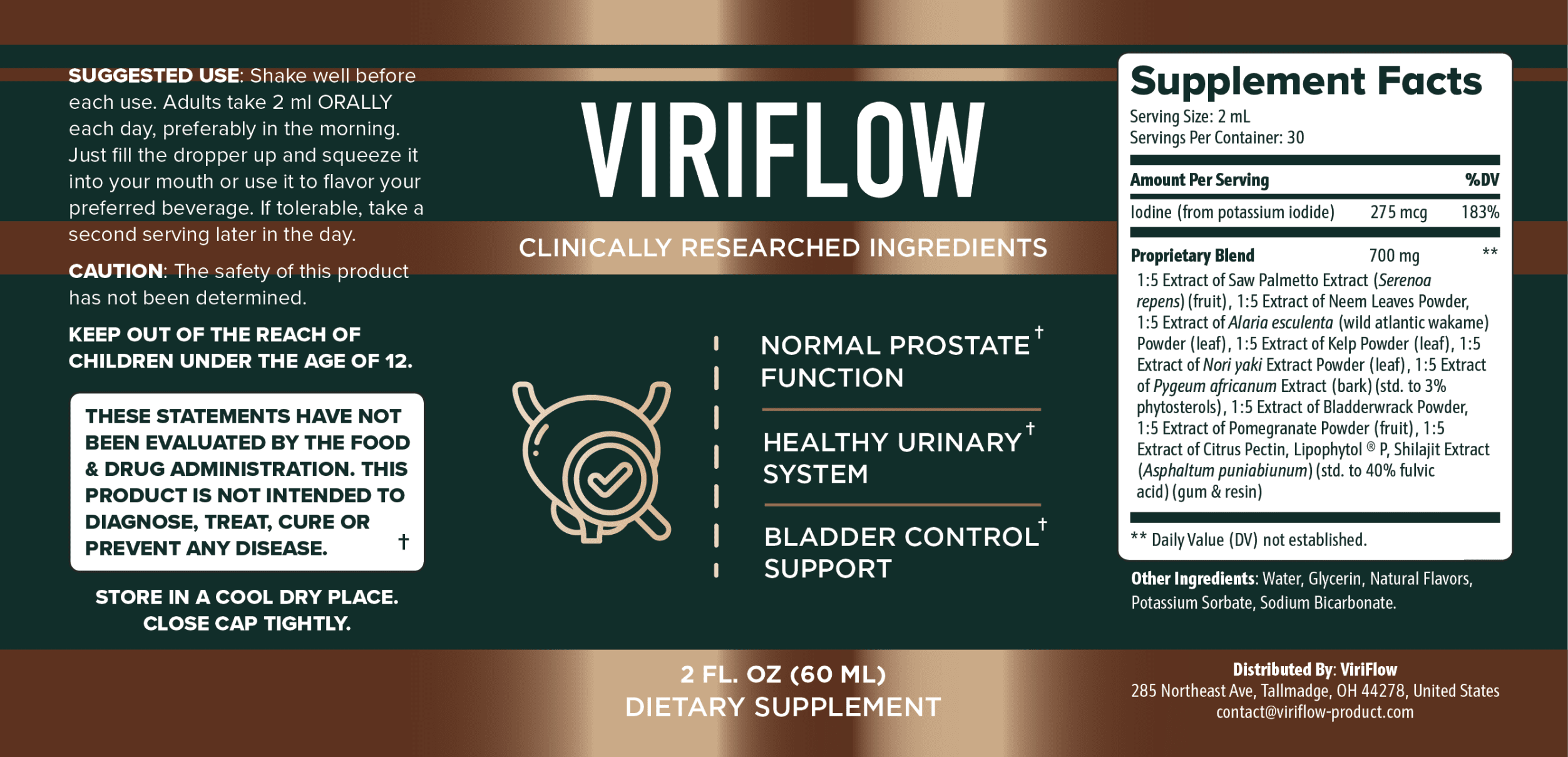
ViriFlow side effects are unknown for the product itself: no safety study exists, and the label says "The safety of this product has not been determined."[1] The clearest risk is iodine. Each 2 ml serving lists 275 mcg, 183% of the Daily Value, and kelp, bladderwrack, wakame and nori in the blend add an amount the label does not state. The vendor FAQ, by contrast, says every ingredient is "proven to be safe in clinical trials".[2]
Is ViriFlow safe? ViriFlow side effects at a glance
Its safety is not established, and the iodine load is the first thing to check. Excess iodine can cause hypothyroidism, hyperthyroidism, goiter or thyroid inflammation, and people with Hashimoto disease or thyroid nodules are most at risk.[3][4]
The adult upper limit for iodine is 1,100 mcg a day from all sources, food included.[3] One serving lists 275 mcg; the optional second serving makes it 550 mcg before any seaweed iodine or diet. Seaweed iodine varies widely: Norwegian habitual seaweed eaters had a median intake of 658 mcg a day, with the top quarter above the upper limit.[5] Because the blend's seaweed iodine is not stated, nobody can calculate the true total.
The second issue is heavy metals. Seaweeds and shilajit can carry arsenic, cadmium or mercury, and ViriFlow publishes no third-party test results.[6][7] We found no ViriFlow reports in the FDA adverse event database (CAERS) and no recalls, checked October 28, 2026.
What ViriFlow side effects are possible?
Expect the effects reported for its ingredients, since nobody has studied the liquid. Most are mild, but the thyroid effects can be serious.
Digestive
Saw palmetto's side effects are mild and infrequent: digestive symptoms, dizziness and headache, according to NCCIH.[8] Pygeum causes mild stomach upset at rates close to placebo.[9] Pomegranate extract caused diarrhea in 13.5% of men at 3 g a day, far above anything a 700 mg blend could hold.[10]
Thyroid and sensitivity
Kelp capsules raised TSH, a sign of thyroid strain, within 4 weeks in healthy adults.[11] Case reports describe hyperthyroidism from bladderwrack, including in a patient taking lithium.[12] Plain citrus pectin caused a rare severe allergy in a person allergic to cashews.[13]
Medication-related
Potassium iodide can raise blood potassium when combined with some blood pressure drugs and water pills.[3] Shilajit raised testosterone in one small trial, so men with prostate cancer or on hormone therapy should ask first (inferred from that trial).[7]
Which ingredients deserve extra attention?
Iodine, the four seaweeds, shilajit and neem carry the clearest warnings in our sources. The label gives no amount for any of them except iodine.[1]
| Ingredient | Safety issue | Why it matters |
|---|---|---|
| Iodine (potassium iodide), 275 mcg | Thyroid dysfunction at high intake | 183% DV per serving before seaweed and food[3] |
| Kelp | Raised TSH in 4 weeks[11] | Kelp is the richest seaweed in iodine[19] |
| Bladderwrack | Hyperthyroidism case reports | One case involved lithium[12] |
| Wakame (Alaria) and nori | Iodine and arsenic | Urinary arsenic rose after seaweed meals[14] |
| Shilajit | Heavy metals in unpurified product | Mercury found in some samples; no test results published[7] |
| Neem leaf | Neem oil is toxic by mouth; leaf poisoning case reported | Keep away from children[15] |
| Saw palmetto | Mild stomach upset, headache | May be unsafe in pregnancy[8] |
The label says to keep it from children under 12, while the sales page calls it "designed for all ages and medical conditions".[1][20] Our ViriFlow ingredients page covers each item's evidence.
Which medicines could interact?
Thyroid medicines, lithium, amiodarone, some blood pressure drugs and blood thinners are the groups to check with a pharmacist before starting.
- Thyroid drugs: levothyroxine and antithyroid drugs such as methimazole; added iodine can push thyroid function either way.[3]
- Lithium and amiodarone: both affect the thyroid or add iodine load.[4][12]
- ACE inhibitors and potassium-sparing diuretics: benazepril, lisinopril, spironolactone, amiloride; risk of high potassium with potassium iodide.[3]
- Blood thinners: warfarin and antiplatelet drugs. Fucoidans from brown seaweeds slowed clotting in lab and animal work; no human bleeding cases were found, so this caution is inferred.[16]
- Hormone therapy for prostate cancer: shilajit raised testosterone in one trial.[7]
- Prostate medicines: tell your doctor about any supplement if you take BPH drugs.[9]
Pregnancy, breastfeeding and who should ask a doctor first
These groups should get a doctor's advice before taking ViriFlow:
- anyone with Hashimoto disease, Graves disease, thyroid nodules or past thyroid surgery;[4]
- anyone taking a thyroid drug, lithium, amiodarone, an ACE inhibitor or a potassium-sparing diuretic;
- anyone on warfarin or another blood thinner;
- men with urinary symptoms that have not been checked, since NIDDK notes they can come from infection, bladder problems or prostate cancer;[17]
- men with prostate cancer or on hormone therapy;
- pregnant or breastfeeding women: saw palmetto may be unsafe, and seaweed overuse has caused thyroid problems in newborns through breast milk;[8][18]
- children under 12, per the label.[1]
Which symptoms need a doctor right away?
Stop ViriFlow and get medical care right away if you:
- cannot urinate at all;[17]
- have urgent, painful urination with fever and chills;
- see blood in your urine;
- have great pain in your lower belly or urinary tract;
- notice swelling in the front of your neck (a possible goiter);[3]
- have a burning mouth or throat, fever, vomiting or a weak pulse, signs NIH links to very high iodine doses.[3]
For the dose and timing the label gives, see our guide to taking ViriFlow.
ViriFlow safety conclusion
ViriFlow's safety has not been determined, by the label's own words. For most healthy adults, a single serving lists iodine below the upper limit, but the seaweed iodine is unknown and no heavy-metal testing is published. If you have a thyroid condition, take thyroid drugs, lithium or a blood thinner, or have prostate symptoms nobody has checked, see a doctor before you buy. Whether it works at all is covered on our does ViriFlow work page.
Back to the ViriFlow overview.
Frequently asked questions
Can ViriFlow affect your thyroid?
It can. Each 2 ml serving lists 275 mcg of iodine, 183% of the Daily Value, and four seaweeds add an unstated amount. Excess iodine can cause hypothyroidism, hyperthyroidism or goiter, especially with Hashimoto disease or thyroid nodules.
Does ViriFlow have heavy metals?
Nobody has published test results for ViriFlow. Its seaweeds can carry arsenic and cadmium, and unpurified shilajit has contained mercury and other metals in studies. The vendor shows no third-party heavy-metal testing, checked October 28, 2026.
Can I take ViriFlow with blood thinners?
Ask your doctor first. Fucoidans from brown seaweeds slowed clotting in lab and animal studies. No human bleeding cases were found, so the risk is inferred, but ViriFlow hides its seaweed doses, which makes it impossible to judge.
Can ViriFlow cause stomach upset?
It may. Saw palmetto can cause mild digestive symptoms, dizziness and headache, and pygeum causes mild stomach upset at rates close to placebo. No study has measured side effects of the ViriFlow liquid itself.
Is ViriFlow safe for older men?
The label says its safety has not been determined. Older men are more likely to take thyroid, blood pressure or blood-thinning medicines that matter here, and urinary symptoms at any age should be checked by a doctor before using a supplement.
Sources
- ViriFlow Supplement Facts label image. ViriFlow vendor, read October 28, 2026.
- Contact us and FAQ. ViriFlow vendor, read October 28, 2026.
- Iodine: Fact Sheet for Consumers. NIH Office of Dietary Supplements, read October 20, 2026.
- Iodine excess and thyroid dysfunction, review. PubMed abstract, read October 20, 2026.
- Iodine intake in habitual seaweed consumers in Norway. PubMed abstract, read October 28, 2026.
- Edible seaweed: health benefits and risks, review. PubMed abstract, read October 20, 2026.
- Heavy metals in shilajit, review. PubMed abstract, read October 20, 2026.
- Saw Palmetto: Usefulness and Safety. NCCIH, read October 2, 2026.
- Pygeum africanum for benign prostatic hyperplasia. Cochrane Database of Systematic Reviews, 2002, read October 20, 2026.
- Pomegranate extract dose-ranging trial in men with rising PSA. PubMed abstract, read October 20, 2026.
- Kelp supplementation and thyroid function, double-blind trial. PubMed abstract, read October 20, 2026.
- Fucus vesiculosus induced hyperthyroidism in a patient on lithium, case report. PubMed record, read October 28, 2026.
- Citrus pectin anaphylaxis with cashew cross-reactivity, case report. PubMed abstract, read October 20, 2026.
- Urinary iodine and arsenic after seaweed meals. PubMed abstract, read October 28, 2026.
- Neem oil poisoning in a child, case report. PubMed abstract, read October 20, 2026.
- Anticoagulant activity of fucoidans. PubMed record, read October 28, 2026.
- Enlarged Prostate (Benign Prostatic Hyperplasia). NIDDK, read October 2, 2026.
- Neonatal hypothyroidism from maternal seaweed intake via breast milk. PubMed record, read October 28, 2026.
- Iodine content of 348 Korean seaweed samples. PubMed abstract, read October 28, 2026.
- ViriFlow sales page. ViriFlow vendor, read October 28, 2026.
This page is general information, not medical advice. Dietary supplements are not reviewed by the FDA for safety or effectiveness before they are sold and are not intended to diagnose, treat, cure or prevent any disease. Talk to your doctor before taking any supplement, especially if you are pregnant, nursing, take medication or have a health condition.